The technical implementer · Abuja, Nigeria
Digital public infrastructure (DPI) implementation in Nigeria
You hold the mandate for a digital ID layer, a registry, a data exchange or a credentials system. You need a team that will build it, make it work in the field, and leave you in control of it.
SENPAI is the technical implementer in the room. We design, build, pilot and hand over the working parts of national and sector-level digital systems, alongside the lead contractor, the funder and your own team.
Start with a live pilot: a working system in a few weeks, not a procurement cycle, and cheap enough to test the idea in the field before you commit the programme.
Based in Abuja. Built to run offline, on open standards, and owned by you.
- What people useHealth, energy, education, public services
- What we build and run · live pilot firstRegistries, consent, verification, offline systems
- What government ownsDigital identity, payments, data exchange, trust services
If you carry the mandate, or fund it.
Ministries, departments and agencies
You hold the mandate for a digital ID layer, a registry or a data exchange. You have a policy, a budget line and a deadline, and a procurement process that tends to reward a document over a working system.
We build the part that has to work, run the pilot that proves it, and leave you in control.
Development partners, DFIs and foundations
You fund the rails and need implementation on the ground that outlasts the project cycle, with results you can report against a baseline.
We implement locally, measure against a baseline set before we start, and hand over systems the country owns.
Lead contractors and integrators
You hold the contract and need a local team that knows how the field behaves, to deliver a defined part of it well.
We take a defined part: a registry, an offline front end, a verification layer, a pilot.
Health, energy, education and public service programmes
Your records are split across facilities, districts or spreadsheets, and nobody can say which are right.
We start with one use case and one first adopter, and build the smallest working block that fixes it.
How digital public infrastructure projects fail, and how we avoid it.
Digital identity, registry and data-sharing projects rarely fail on the technology. They fail in the gaps between the people who plan them, the people who build them and the people who have to use them. These are five common failures, with a documented example of each, and what we do about it.
- 253 of 950facilities reached
Built to a plan, never tested in the field
Ghana’s national hospital system (2016 to 2024) reached 253 of a targeted 950 facilities. Frequent outages sent hospitals back to paper.
What we doWe put a live pilot in front of real users early, in real conditions, while a change is still cheap. It is built offline-first, for power cuts and lost signal.
- 90.9%of FCT hospitals run their own serial numbers
Replacing what already works instead of adding to it
In a study of 11 public hospitals in the FCT, 90.9% issued patient numbers as plain serial numbers of their own. A new system that ignores them adds one more card.
What we doWe add one capability to what exists and wrap existing systems instead of replacing them. We build on the national identity number and the registers already in place, and each institution keeps its own records.
- ~40%of India’s health IDs created through one vaccination platform
Adoption forced before it is useful
In India, roughly 40% of health IDs were created through the vaccination platform, often without clear consent. Mandated open-banking APIs have produced “checkbox” implementations that change nothing for the customer.
What we doAdoption is voluntary and earned. Verification is optional and never a condition of getting a service. Consent is specific, recorded and revocable.
- 1 vendorand no common data standard
A vendor you cannot leave
Ghana’s system did not follow the common data standard of its field (FHIR), ran on one vendor’s stack, and its cloud was reportedly outside the country, which raised sovereignty concerns.
What we doOpen standards from the start. You own the code, designs, data and accounts from the first day, and the system can move to your servers.
- Day 2is where capacity usually runs out
A launch, then silence
Capacity is the usual bottleneck. Systems are handed to teams that cannot yet run them, and they decay.
What we doWe stay through the pilot and put the lessons back into the design. Then we hand it over and train your team, or keep running and improving it with you for as long as you want. Both are on offer.
Examples: Ghana's LHIMS, published review. FCT hospitals, patient ID study. India's health IDs, Privacy International. Mandated APIs, Centre for DPI.
New, small and fast is the advantage here.
Big programmes buy certainty with time and money. We buy it with evidence. A live pilot, built quickly by a small team, tells you what a plan cannot, and costs far less than finding out after the full rollout.
A live pilot, early and cheap
We put a working system in front of real users in a few weeks, not after a procurement cycle. A live pilot shows what breaks while changing it is still inexpensive, so you test the idea in the field before you commit the programme budget.
Our prototypes are live and open today: a health ID, an energy data service, an ecosystem record and a plain-English law library.
Lower cost
A small senior team with no large bench and no layers of overhead builds directly. You pay for the work and not for the structure around it.
We run production systems on our own infrastructure, so there is no cloud reseller or licence in the chain.
Faster cycles
The people who find the problem in the field are the people who fix it. A change goes from a finding to a release quickly, not through a chain of approvals.
The energy dashboard keeps collecting and is still being improved as it runs.
People who keep it running
We can hand the system over and train your team. We can also keep maintaining and improving it, using our core team and the vetted engineers and designers of the Senpai Collective.
You own the system either way. Running it with us is a choice, not a dependency.
The building blocks of a national digital system.
A health service, a grid report and a programme register look different from the outside. Underneath they ask the same questions. Who is this? What do we know about them, and who confirmed it? Who may see it, and for what?
- Digital ID layersVerification and authentication on top of an existing identity, such as the national identity number. Built so that verification is optional, nothing sensitive is stored, and nobody is refused a service for not verifying.
- RegistriesA single, structured record of people, facilities, professionals, organisations or communities, with the source of every entry shown and a way for the party described to claim and correct it.
- Consent and data sharingConsent that is specific, recorded and revocable, and data that stays where it is held, shared through open standards rather than copied into one large store.
- Verifiable records and credentialsRecords and certificates a third party can check, including signed QR codes on paper documents. We have built a verification record for the Senpai Collective, and the same approach applies to licences and certificates.
- Open data and APIsPublished and official data collected, checked and served through a documented interface, so software can use it directly instead of reading a PDF.
- Offline and field systemsApps that register, record and sync without a connection, on the phones the people doing the work already carry.
- Many front ends, one back endWeb and mobile today. WhatsApp and SMS front ends on the same back end, so a service reaches the person on the device they have.
- Operation and improvement over timeWe run production systems and can keep maintaining and improving them for as long as you want, with our core team and the engineers and designers of the Senpai Collective. Host with us while it suits you, or take the system to your own servers at any time.
From a mandate to a system live in the field.
Frame the problem and map what exists
Who depends on the service, where it breaks, and which systems and registers are already in place. The output is a plan to add one capability to what exists.
Choose the first use case and first adopters
A use case people need often, that covers many of them, and that the responsible office will back. Where we can, we pursue three use cases and three adopters in parallel.
Build the smallest working block
On existing systems and open standards wherever possible. A working first version within a few weeks, not a specification that waits for a procurement cycle.
Run a live pilot and measure
Real users, real conditions, a baseline set before we start. A live pilot is the fastest and cheapest way to find what breaks, and it is there to do that, not to prove the work succeeded.
Hand over, or keep running it with you
Either your team is trained and the system is documented, or our team keeps maintaining and improving it alongside yours, for as long as you want. You own the system either way.
Each began with a problem and a story.
We build these unasked, in the open, before a partner is paying us to find out what works. Each one says what stage it is at, and none is a national deployment yet.
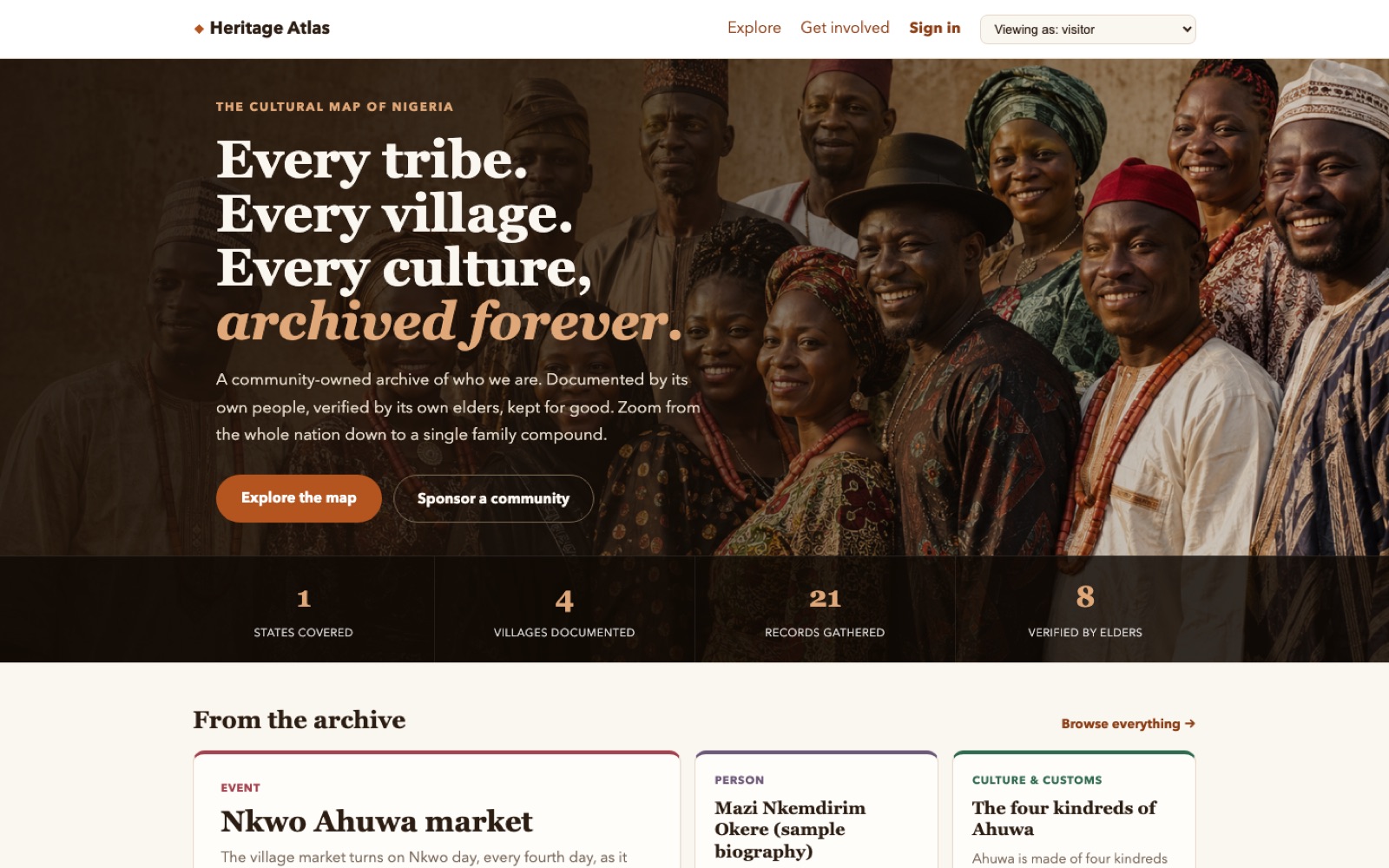
Heritage Atlas
The cultural map of Nigeria
Nigerian cultural knowledge lives almost entirely in people. When a custodian dies without being recorded it is simply gone, and the archives that do exist were mostly built by outsiders looking in.
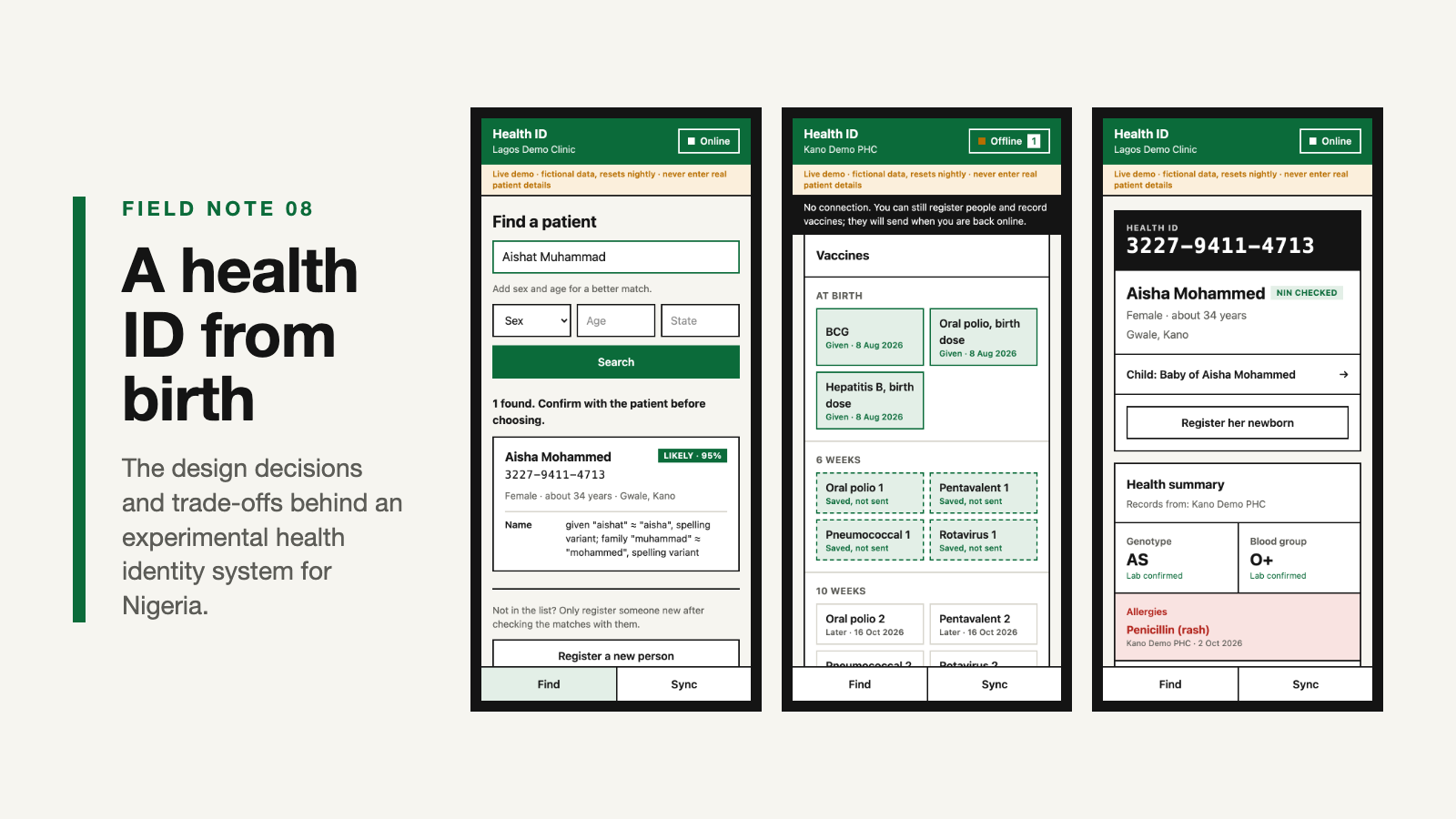
Health ID
A health ID from birth
Every Nigerian who has used more than one hospital owns more than one hospital card. A child's vaccinations are split across clinics, so nobody can say which doses were missed. Revitalised primary health centres alone record around 45 million visits a quarter, by the Minister of Health's own figure, and each visit can mint another card.
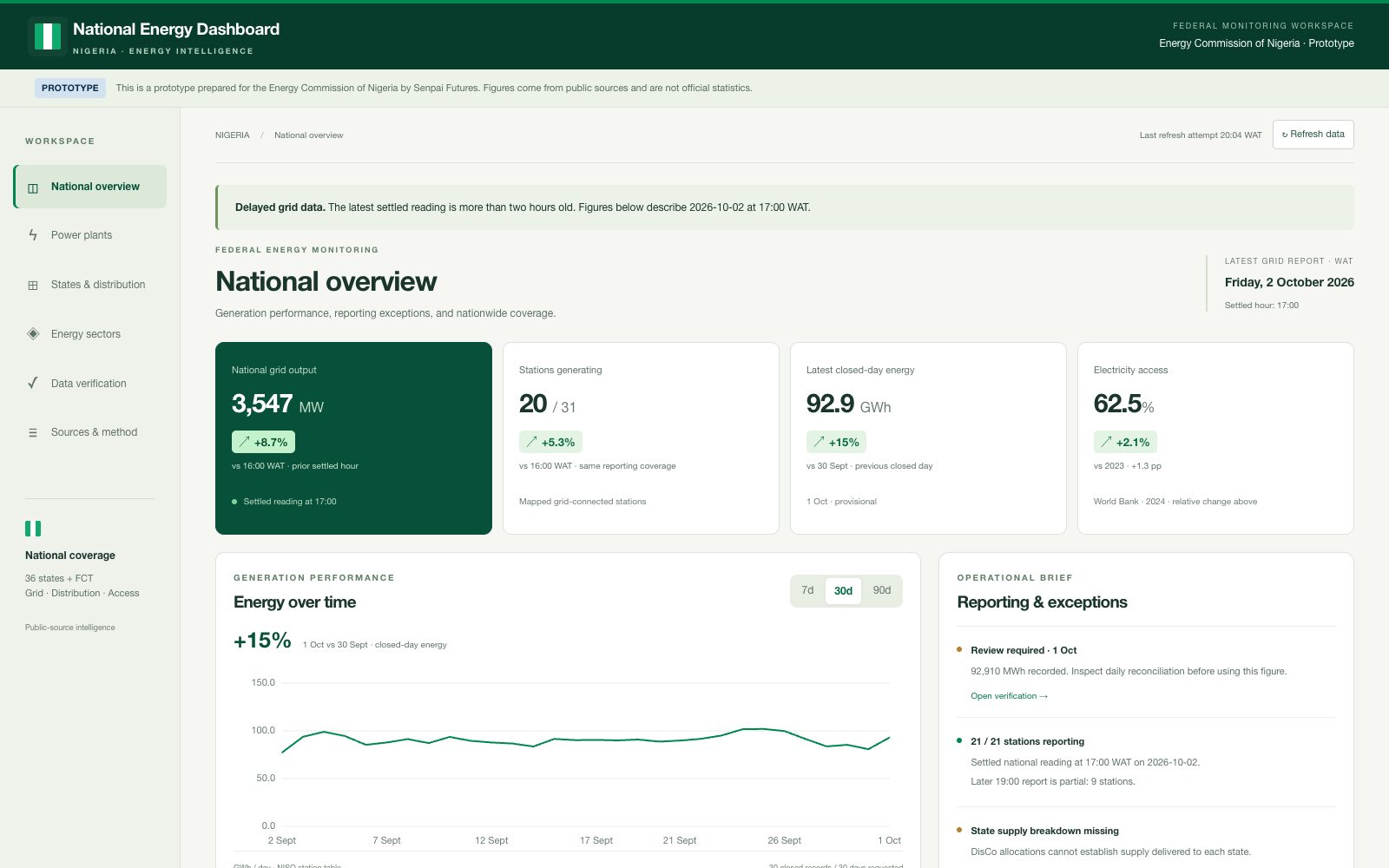
National Energy Dashboard
Nigeria's power data, checked
Nigeria's hourly grid figures are published, but they are self-reported by the generation companies, and the sites that republish them do not check them. Anyone who needs a number they can rely on, for a report, a model or a decision, has no way to tell a sound figure from a doubtful one.
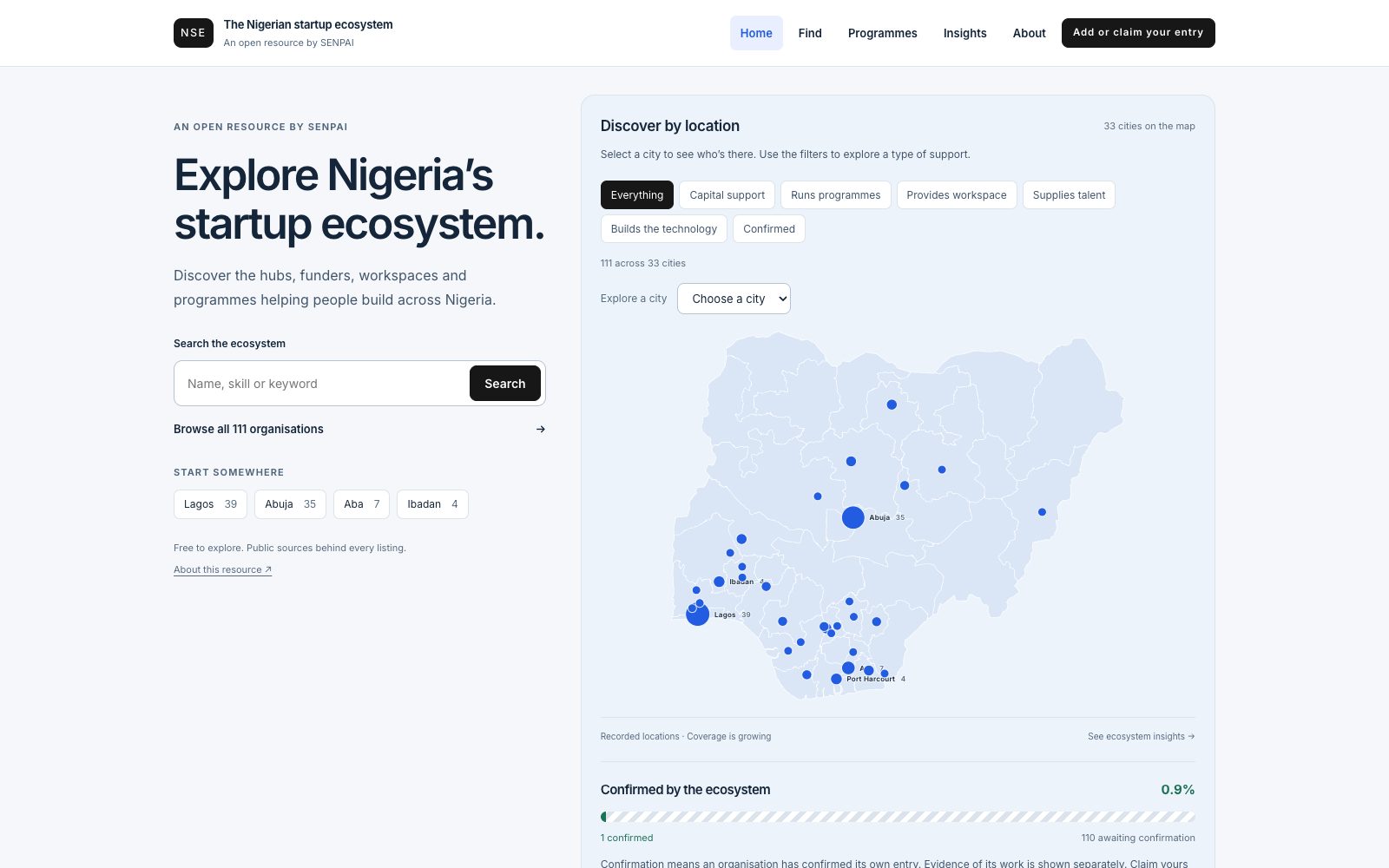
The Nigerian Startup Ecosystem Record
A record that shows its sources
Every hub, network and fund convenes real people and moves real money, and almost none can produce evidence of either. The value in the ecosystem is a graph, and nobody holds it. Existing lists go stale, point to dead sites, or repeat what an organisation says about itself with nothing behind it.
Civic Notes
Nigerian law in plain English
The law is written for lawyers. A shop owner, a voter or a startup founder who wants to know what an Act means for them has to read statute text or trust a summary, and has no way to tell whether the summary is right.
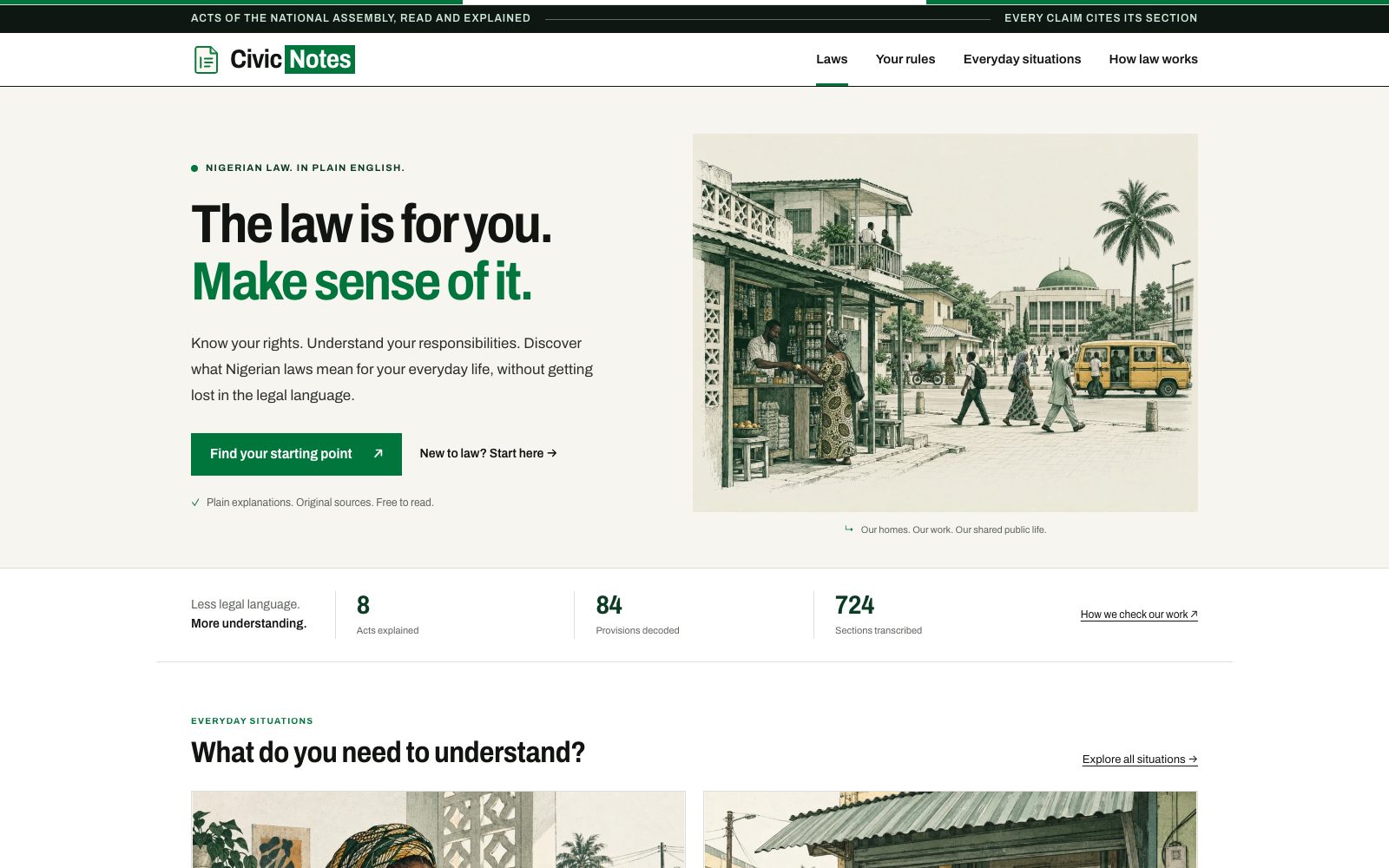
Small, open, and added to what exists.
Nigeria is building its digital public infrastructure: identity and trust services around the national identity number, a Presidential Committee coordinating the rollout, and a mature payments network. We build the layer that sits on those rails, and nothing we build competes with them.
Open specifications
We publish how a record is shaped and use the standards each field already has, such as FHIR for health records.
Small, reusable parts
One function done well, then reused. The same record pattern, a source, a confirmation and an owner, runs under the ecosystem record and the Heritage Atlas.
Data stays where it is held
The institution that holds a record keeps it. What travels is an identifier and the minimum a service needs, under the person’s control.
Private by design
Sensitive identifiers are used once and not stored. Consent is recorded per use. Each system holds as little as it can.
Voluntary, not forced
Adoption works when it is useful to the people and the institutions involved. Verification is offered and never a condition of getting a service.
Start from what exists
Built on the national identity number and the registers already in place, not against them. The ecosystem record reads each organisation’s own website. The energy dashboard collects data the grid already publishes.
What a new company means for you.
SENPAI is a new company, built on years of work in this ecosystem. We say so plainly, because it shapes how we work: we prove it with a pilot first, we take defined parts, and we put the terms in writing before work starts.
- We take bounded parts.A pilot, or a defined piece beside a lead partner, with the terms in writing before work starts.
- You own it.Code, designs, data and accounts are yours from the first day, so working with us is never a trap.
- The proof is public.Working systems you can open today, and field notes that record the trade-offs, the mistakes and what is not built.
- People to keep it running.A core team, and a bench of designers and engineers from the Senpai Collective, each with a record of reviewed work you can check. They can maintain and improve the system after launch if you want that.
- Procurement documents on request.Company registration and the documents your process asks for, available when you want them.
Three ways in.
A live pilot
One use case, one first adopter, a real setting, live in a few weeks. We build it, run it with the people who use it, and measure what happened. It is the cheapest way to test the idea. This is how every project below began.
A defined part, beside a lead partner
Where a programme already has a lead contractor or a funder’s implementer, we take a bounded piece: a registry, an offline front end, a verification layer.
Diagnosis and technical advice
A read of an existing system, an architecture that adds one capability to what is already there, and a plan sized to the team that will run it.
Digital public infrastructure in Nigeria, answered.
What is digital public infrastructure (DPI)?
Digital public infrastructure is a set of shared, open building blocks, such as digital identity, payments, data exchange and verifiable credentials, that governments, businesses and communities build services on. The aim is that each service does not rebuild the same basics, and that systems connect through open standards instead of being locked to one vendor.
Does SENPAI implement digital public infrastructure in Nigeria?
Yes. We design, build and pilot DPI components, then hand them over or keep running them with you: registries, identity and consent layers, data exchange and verification, with offline field systems. The systems we have built so far are prototypes and pilots that we made ourselves, such as a national energy data service, a startup ecosystem record, a plain-English law library, a cultural archive and a health ID. None is a national deployment yet, and we say so on every page.
Can a young company take on national digital work?
Not the whole of a national programme on its own, and we do not claim to. We take defined parts under a lead partner, or run a pilot, with terms in writing and everything owned by you from the first day. SENPAI is a new company, and what we bring is working systems, published decisions and a team that carries a project from diagnosis to a live pilot.
Why choose a new company over an established firm?
Speed, cost and evidence. A small senior team with no large bench carries less overhead, so a pilot costs less, and the people who find a problem in the field are the ones who fix it, so changes ship quickly. A live pilot then tells you what a plan cannot, before you commit a full programme budget. What an established firm has and we do not is a long national track record, which is why we start with pilots and defined parts and publish our results.
How quickly can a pilot be live?
It depends on the scope, but we work in weeks, not procurement cycles. A first working version typically takes a few weeks. Our health ID prototype, with offline registration and sync, and our energy dashboard were both built by a small team and put online as public demos. A pilot with real users takes longer, and we agree the plan and the baseline with you first.
Who owns the system we commission?
You do. Code, designs, data and accounts are yours from the first day. There is no licence to renew and no dependency on us to keep it running. You can host with us or take it to your own servers.
Can SENPAI maintain and improve the system after it launches?
Yes, if you want us to. We can hand the system over and train your team, or keep maintaining and improving it alongside yours, using our core team and the vetted engineers and designers of the Senpai Collective. You own the system either way, so running it with us is a choice and never a dependency.
Do you use open standards and open source?
We start from open standards and from the open-source building blocks the field already has, and review them before building anything new. Where a field has a standard, such as FHIR for health records, we use it, and we publish the reasoning behind each design decision.
How do you protect privacy and consent?
Each system holds as little as it can. Consent is specific, recorded and revocable. Identity verification is optional and never a condition of getting a service, and sensitive identifiers are used once and not stored. Public demos use fictional people only.
Can you work with our existing systems and vendors?
Yes. We prefer to add one capability to what you already run, wrapping existing systems instead of replacing them. That is faster, cheaper and easier for the people already using them.
Where are you based, and where do you work?
We are based in Abuja, Nigeria, and work across the country. Field research happens where the system actually runs, with people who live in the market.
How do we start, and what does procurement look like?
Start with a conversation. Most engagements begin with a small, scoped diagnosis or pilot. Every phase stands alone and delivers something usable. Procurement documents are available on request.
Tell us the system, who holds the mandate, and where it stands.
Three specifics are enough for us to tell you whether we are the right implementer: who you are, what has to exist, and what stage it is at.
- You get a straight answer on fit. If we are not the right team, we say so and point you at who is.
- If it fits, we propose a first step. Usually a short, scoped diagnosis or a pilot, with the terms in writing before work starts.
- Procurement documents on request. Registration and the papers your process asks for, when you want them.
Looking for studio work or a partnership for a hub or accelerator instead?Studio and partnerships have their own pages.