A social impact design and technology company · Nigeria

We design, build and pilot the digital systems Africa needs.

We work with institutions, government agencies, startups and NGOs to improve how people move, learn, get power, get care and access public services.

We turn those problems into working technology, then test and improve it with the people who depend on it.

Abuja City Gate with the Nigerian flag, landscaped public grounds and roads beyond
Abuja, NigeriaWhere we work
Photo: Jummy001· CC BY-SA 4.0 · Resized and cropped
Strategy

Where the problem actually sits, who it affects and what would move it. Field research, service design, impact strategy.

Design

Brand, product and service design. The craft that makes a thing usable, trusted, and worth coming back to.

Technology

Platforms, apps and the software underneath them, including digital public infrastructure. Built to run, deployed live, owned by you.

Creative

Film, photography, writing and the content around a launch. Work nobody understands does not travel, and work that does not travel does not change anything.

Programs

Training, fellowships and accelerators. We design them, run them, and build the software underneath that shows what they actually produced.

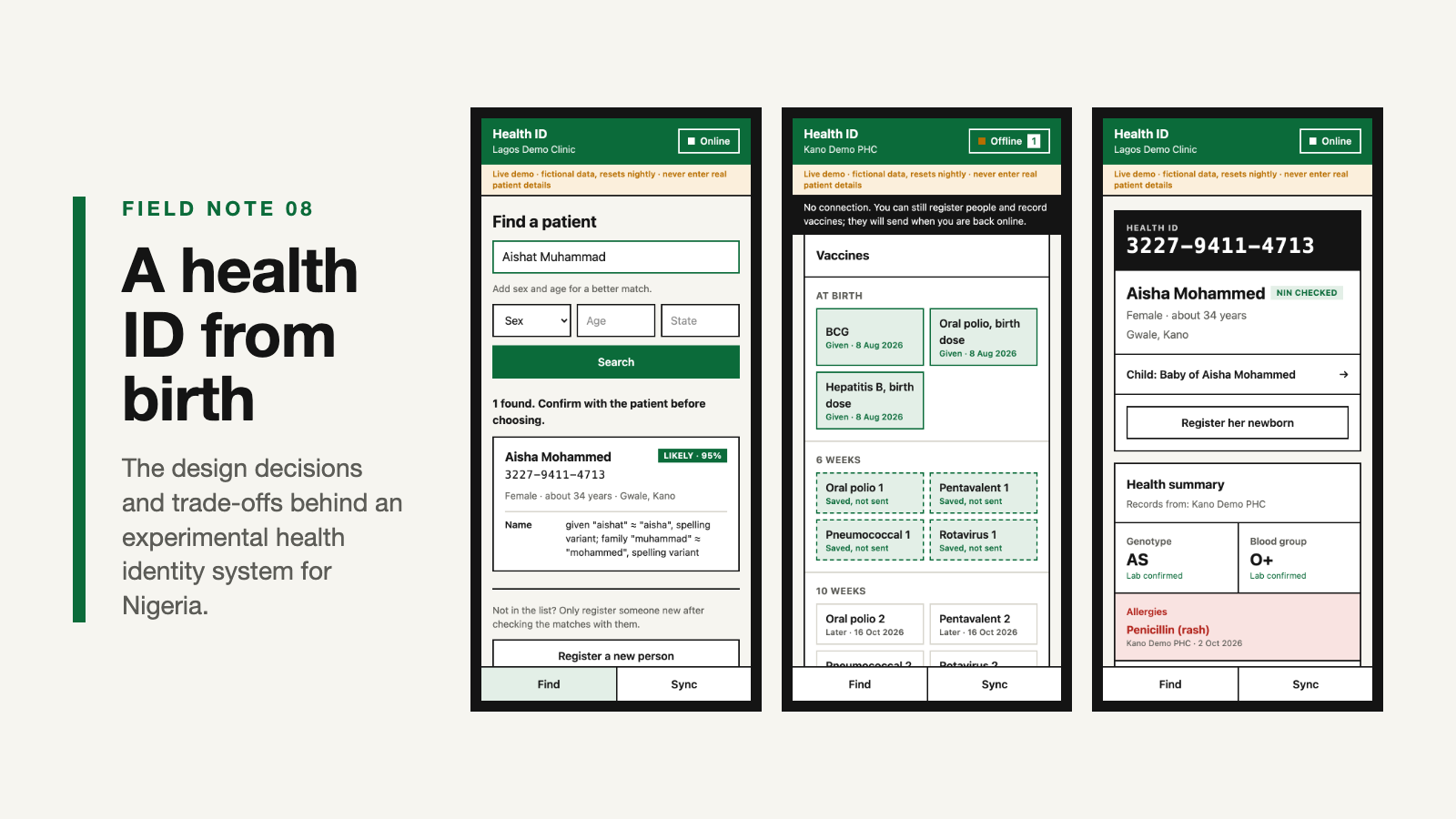
  1. A health ID from birth, and every trade-off behind it

    An experimental answer to a NITDA Builders Festival challenge: why a "health BVN" on its own would not work, why we built on the NIN instead of competing with it, why the ID is issued at birth or at the first vaccination, how bulk-issued IDs make offline registration possible, the portable summary that travels with the ID, how matching, consent and sync are designed, the bugs that taught us the most, and what is still not built.

    Read →
  2. Can a stranger tell what your organisation does?

    Every entry in the Nigerian startup ecosystem record now shows the sentence it came from, the page it was read on and the date. What reading 109 organisations' own websites turned up: five compromised sites, four dead addresses, and an ecosystem that runs programmes and rarely writes cheques. Plus the four things I got wrong doing it.

    Read →
  3. What we found building the Nigerian ecosystem record

    The Nigerian startup ecosystem record is live with 110 organisations across 34 cities. Why it has to be a source of truth rather than another index, the three domains taken over by gambling sites, the design I got wrong four times, and the problem nobody has solved: how a record like this stays true after the people who built it get busy.

    Read →
All writing

Africa is not short of talent.It is not short of ideas.

It is short of systems that still work two years after launch.

What it needs is institutions that build the systems people depend on, and the people who keep them running.

That is the institution we are building.

Why we exist

To inspire and support the next generation of builders taking on the hard problems in Africa, and to be the institution that backs them while they do it.

Our mission

Harnessing the creative potential of young people in Africa to turn good ideas into things that last: products people use, institutions people trust, and infrastructure people depend on.

Our vision

A world where African talent builds the institutions, technologies and ecosystems a better future depends on. Where those systems are still running years after they are handed over, and where nobody has to leave the continent to be paid what their skill is worth.

Aligned to

Our work maps to three UN Sustainable Development Goals. Where a partner reports against them, we build the measurement in from the start.

  • Goal 8Decent work and economic growth
  • Goal 9Industry, innovation and infrastructure
  • Goal 11Sustainable cities and communities
02  How we work

From an idea to a system live in the field.

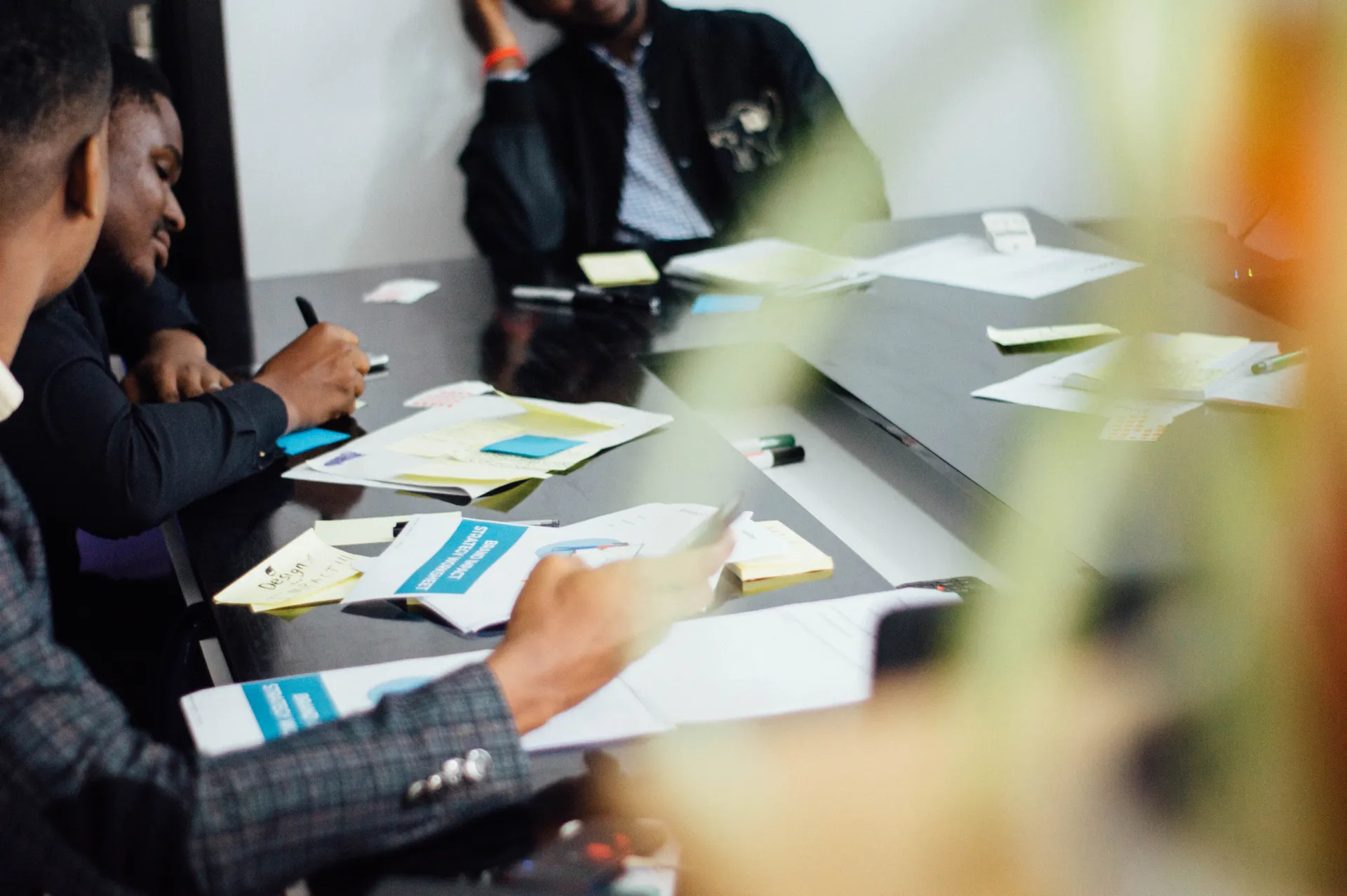
Work like this is usually split in two: one firm writes the strategy, another builds something else from it, and nobody owns the gap. We carry the whole arc. We stay involved through the pilot, testing and improving the system with the people who use it.

People working through ideas together around a table with notebooks and sticky notes.
  1. 01

    Diagnose

    We map the system as it actually is: how it runs, who it serves, where it breaks and who that damages. Root causes, not symptoms.

  2. 02

    Design

    Rebuilt from first principles against targets agreed before anything is made. Outcomes, not a feature list.

  3. 03

    Build

    The working system. Brand, product, and the technology underneath it, deployed live and owned by you.

  4. 04

    Pilot

    Real users, real conditions, real data. The system meets the people it was built for and shows us how it actually behaves.

  5. 05

    Improve

    The data comes back into the design. We change what the pilot exposed, and keep changing it as the system runs.

The pilot is the part almost everyone skips. It is where a system meets the people it was built for and tells you the truth: what breaks, what nobody uses, what to change before you spend real money scaling it. It is not there to make the case that the work succeeded. It is there to produce the data that makes the next version better.

The kind of problem we take on
  • A referral chain that gets a patient from a village clinic to the right hospital, in time.
  • A payroll that pays every teacher in a state on the same day, every month.
  • One place a citizen can see every entitlement they qualify for, and claim it.
  • A land register that holds up in court.
  • A grid that knows which transformer failed before the phones start ringing.
  • A record of a culture, gathered village by village, recorded by the people who hold it and verified by its elders.
National digital projects

We build national digital systems, and we help the teams implementing them.

Digital ID, registries, data exchange, credentials and the services built on top of them. Where a ministry, an agency or a programme holds the mandate, we are the technical implementer in the room: building the part that has to work, or working alongside the lead contractor to get it live in the field. We start with a live pilot that is quick and cheap to run, then hand the system over, or keep running and improving it with you.

Digital public infrastructure →

If one of these is sitting on your desk, we should talk.

Start a conversation →
03  Our own work

We do not wait to be commissioned.

SENPAI runs its own research and builds its own products. Some become companies. Some become systems we hand to the people who need them. All of it is how we learn what actually works, before a partner is paying us to find out.

Research

Field studies of how a system actually behaves, and what it costs the people inside it. Published rather than filed away.

Products

Tools and platforms we build because they should exist and nobody else was going to.

Companies

Where a product earns it, we spin it out and keep building it as its own venture.

Stories

Film, photography and writing, because work nobody understands does not travel, and work that does not travel changes nothing.

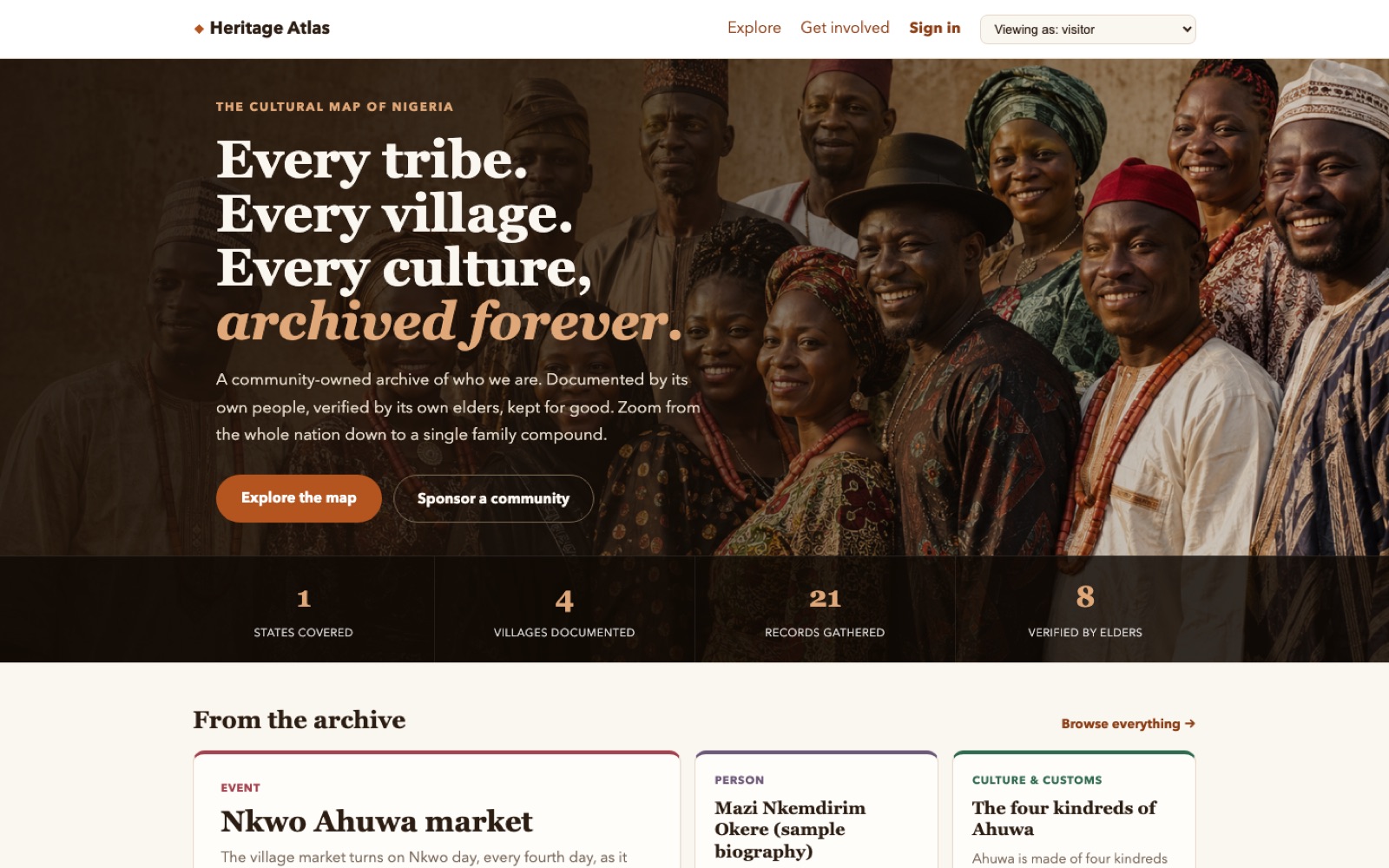
The Heritage Atlas homepage, showing the cultural map of Nigeria
2026In pilotSelf-commissionedDPI

Heritage Atlas

The cultural map of Nigeria

A verified archive of who we are: recorded by the people who hold it, verified by its own elders, credited by name, and kept for good. You can zoom from the whole nation down to a single family compound.

Backend
Go, PostgreSQL, Flag-driven config
Frontend
Nuxt, SPA
Infrastructure
Hetzner, Caddy, systemd, Cloudflare
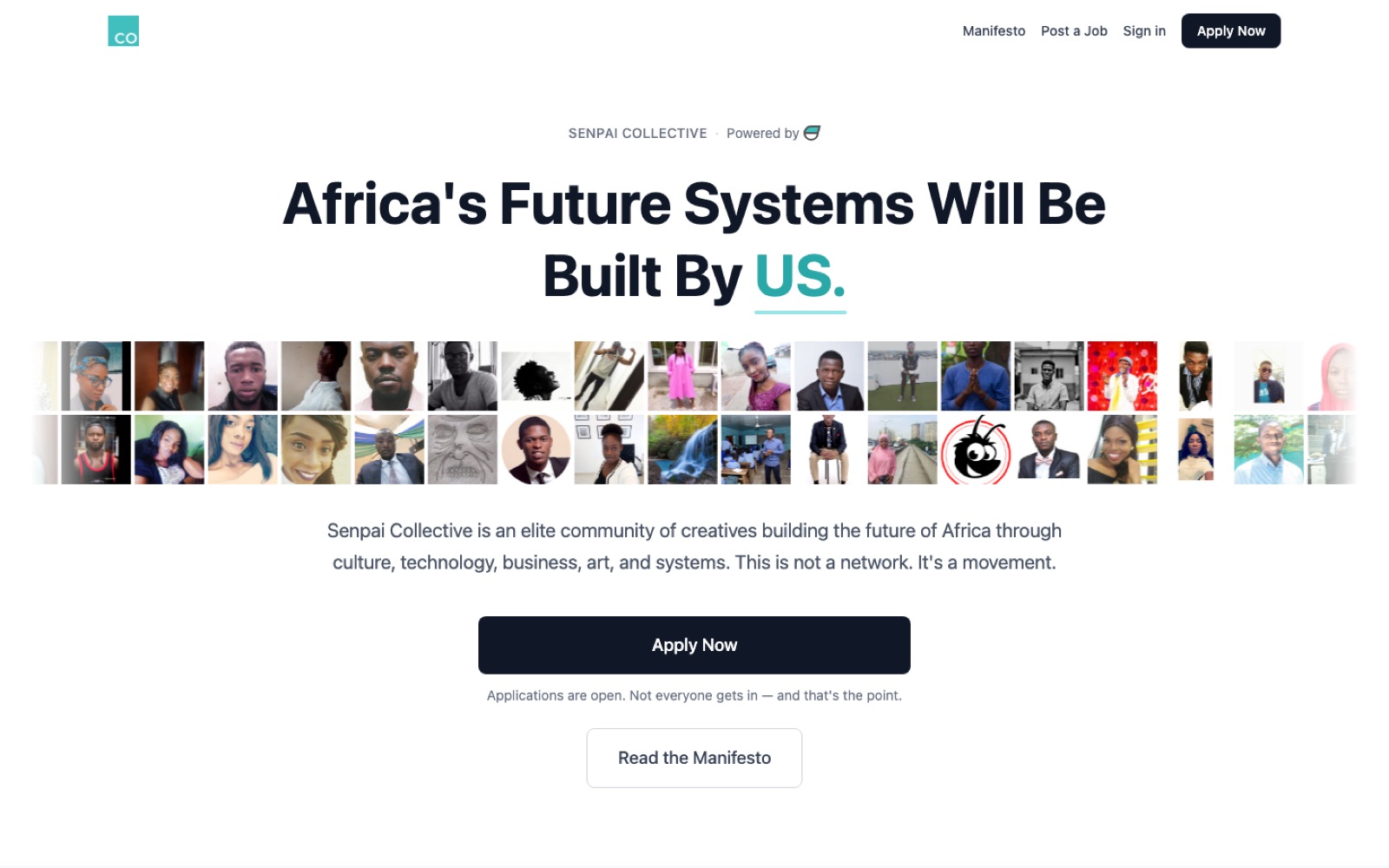
The Senpai Collective homepage, showing members of the community
2026LiveSelf-commissioned

Senpai Collective

The platform the community runs on

A web application that takes an African creative from an application form to paid client work, and turns everything they do along the way into a verification record a client can actually check.

  • 2,000+Community members, 2017 to 2021
  • 4Cohorts, across five tracks
  • 157Enrolled in Design 101 alone
  • 78%Of graduates now earning in dollars
Backend
Go, PostgreSQL, sqlx, go:embed migrations
Frontend
Vue 3, TypeScript, Pinia, Tailwind, Vite
Identity
Zitadel, self-hosted, Headless OIDC, JWT sessions
Infrastructure
Hetzner, systemd, Caddy, Cloudflare Workers, CD on push
The Health ID system diagram, showing a clinic phone, the ID registry and the national identity number
2026In buildSelf-commissionedDPI

Health ID

A health ID from birth

A provisional health ID issued at birth or at the first vaccination, linked to the mother, built on the NIN rather than against it, and designed to keep working in a clinic with no signal. An experimental answer to a problem set by eHealth Africa on the NITDA Builders Festival.

Backend
Go, PostgreSQL, Records presented as FHIR
Frontend
Vue 3, TypeScript, Offline-first PWA
Infrastructure
Hetzner, Caddy, systemd, Cloudflare Workers
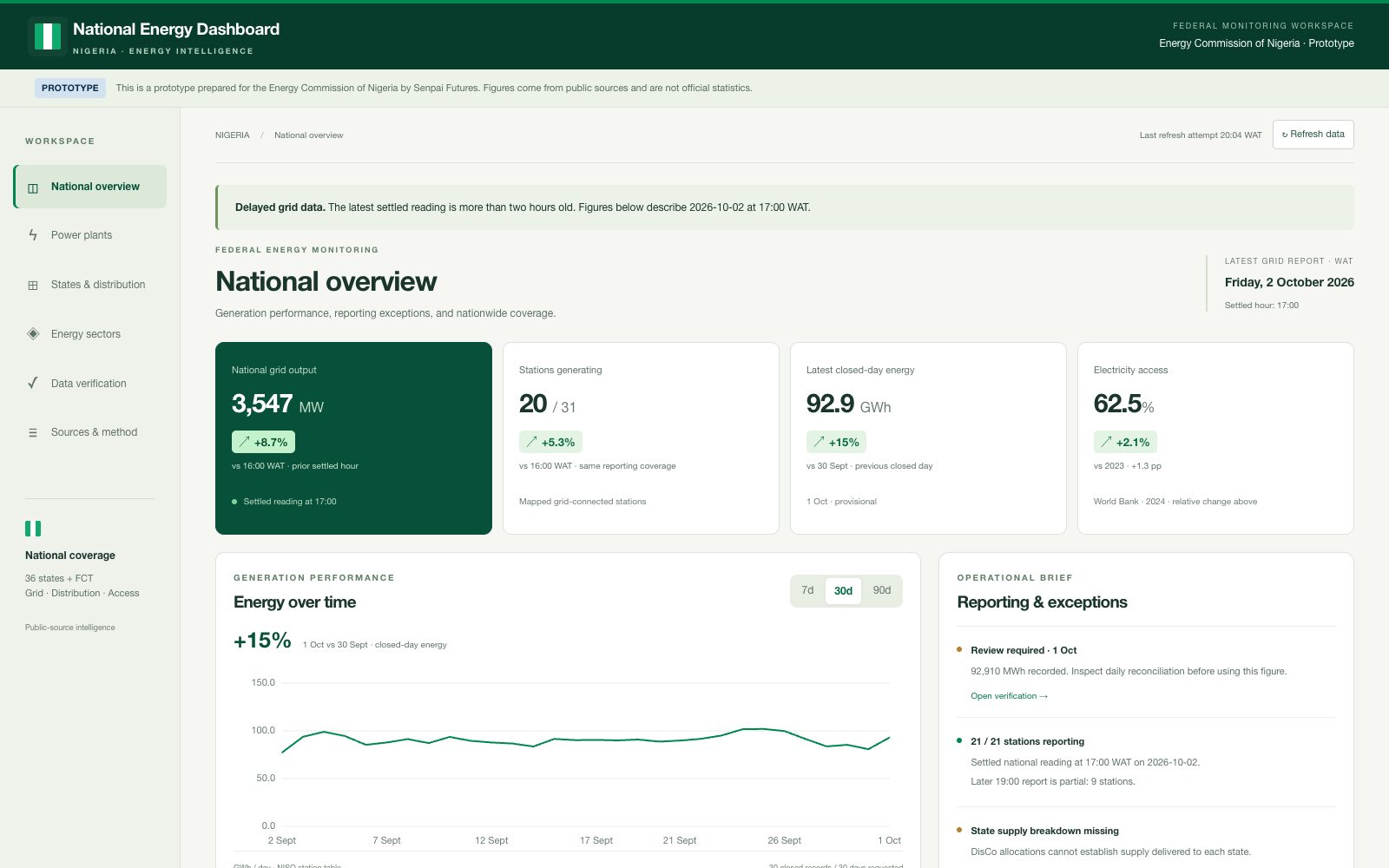
The National Energy Dashboard overview, showing grid output, stations generating and energy over time
2026In buildSelf-commissionedDPI

National Energy Dashboard

Nigeria's power data, checked

A prototype that collects Nigeria's published grid data, backfills it to 2019, tests it against itself, and serves it through an interface, so that software and people can use the numbers without trusting them blindly.

Backend
Go, PostgreSQL, Scheduled collectors
Frontend
Vue 3, TypeScript, Tailwind, Vite
Infrastructure
Hetzner, Caddy, systemd, Cloudflare
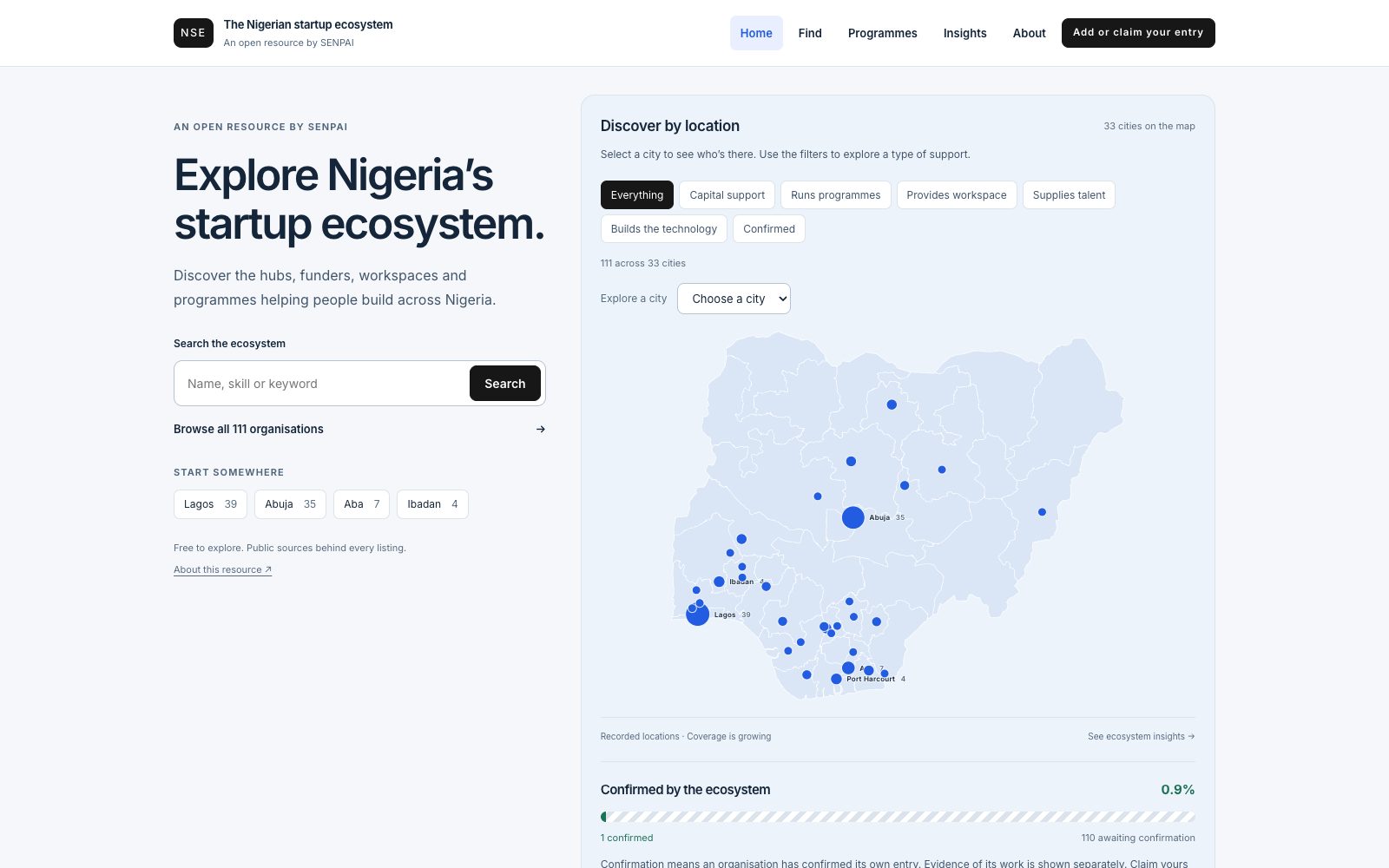
The Nigerian startup ecosystem record, showing a search box, a map of Nigeria with city counts and filters
2026LiveSelf-commissionedDPI

The Nigerian Startup Ecosystem Record

A record that shows its sources

A public register of the organisations that build Nigeria's startup ecosystem. Every entry shows the sentence it came from, the page it was read on and the date, and an organisation can claim and correct its own entry.

  • 111Organisations on the record
  • 33Cities on the map
Backend
Go, PostgreSQL
Infrastructure
Hetzner, Caddy, systemd
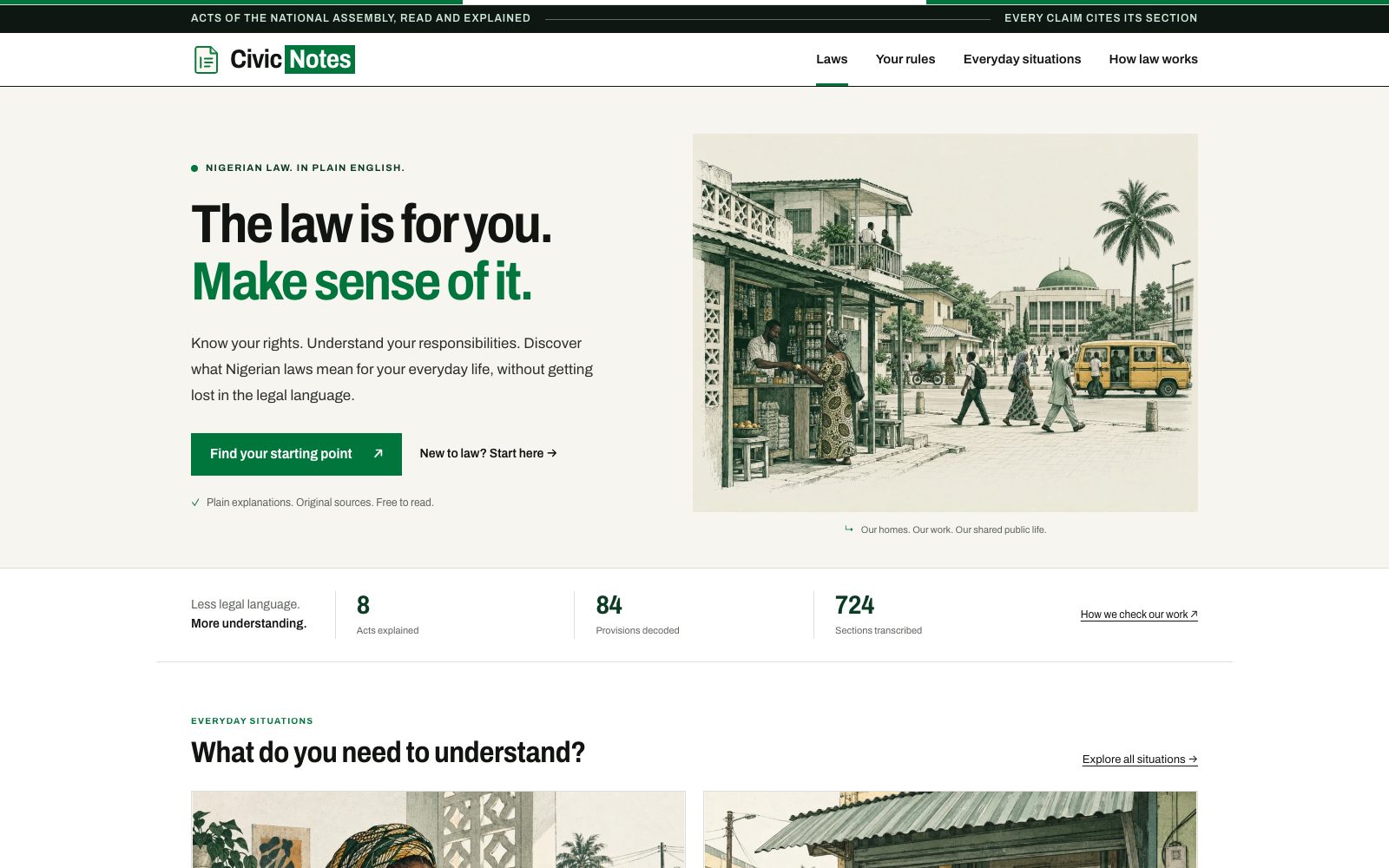
The Civic Notes homepage, with the headline "The law is for you. Make sense of it." and counts of Acts, provisions and sections
2026LiveSelf-commissionedDPI

Civic Notes

Nigerian law in plain English

A free reference that sets the original text of each Nigerian Act beside a plain-English explanation of what it means for you, with every claim linked back to the section it comes from. Eight Acts so far. The explanations are drafts, labelled as such, and awaiting review against the Acts.

  • 8Acts in the collection
  • 724Sections transcribed
Backend
Go, PostgreSQL
Frontend
Astro, Server rendered on Cloudflare Workers
Infrastructure
Hetzner, Caddy, systemd, Cloudflare

Have a system that needs building?

Commission us →
04  The Collective

A home for Africa’s creative tech community.

We’re building a community where designers, developers, writers and makers connect, grow and build together.

Members grow here,
and they build here.

Alongside our core team. What they ship is theirs to carry for the rest of their careers.

  • Brand & identity
  • Product design
  • Frontend
  • Backend
  • Writing & story
  • Photography
  • Film
  • Research
05  Programs

We design programs, and we build what runs them.

We design and deliver learning programmes, and build the tools to manage applications, support participants and track their work.

01

Programme design & delivery

The curriculum, the selection, the cohort, the mentors and the delivery, start to finish.

02

Platforms & participant records

Applications and vetting, cohorts, assignments, peer review, and a contribution record for every participant.

What we run
  • Technical and design trainingBeginner to job-ready
  • FellowshipsAnd talent accelerators
  • Placement programmesEnding in real work, not a certificate
  • Capacity buildingFor teams inside an institution
  • Community documentationTraining people to record their own place
  • Innovation challengesAnd cohort-based builds

A clear record of the work, built as the programme runs. Applications, completed assignments, peer reviews and contributions are kept together. Participants leave with a record of their work, and programme teams can use it to review progress and report to partners and funders.

Programmes we have run
  • Senpai CollectiveA creative community that grew to over 2,000 members between 2017 and 2021.Live
  • Senpai AcademyDesign 101 welcomed 157 students across its cohorts; 45 completed the course.Returning
  • Senpai Talent AcceleratorA six-month programme built around real projects across five creative technology tracks.Past

Have a programme to build or improve?

Discuss your programme →
06  Partnership

Who we work with

If you carry responsibility for a system that people depend on, we want to talk. That is the whole qualification.

Why partners choose us

01

One team for the whole arc

The diagnosis, the design, the build and the pilot come from the same people. Nothing is lost in the handoff between a firm that writes the strategy and a contractor who builds something else from it.

02

You get a system, not a recommendation

The deliverable is a thing running in the field with people using it. A deck that sits on a shelf has cost you a budget cycle and changed nothing.

03

Evidence you can report upward

Baseline measured against outcome, in numbers and in stories. Enough for a board, a ministry or a funder who has to justify the spend to someone else.

04

We are already here

The field research happens where the system actually breaks, by people who live in the market rather than a team flown in for a fortnight.

05

You own all of it

Code, designs, data and accounts are yours from the first day. No dependency on us to keep it running, and no licence to renew.

06

Enter wherever you are

Every phase stands alone and delivers something usable. Start at the diagnosis or bring us in mid-way. You decide how far we go together.

Most organisations can show activities. Few can show outcomes. That is the difference the pilot buys you, and it is why we would rather run one honest pilot than ship something nobody measured.

Start a conversationProcurement documents available on request
Also available

Studio work

Smaller, fixed-scope engagements for founders and businesses who need one thing built well: a product launched in four weeks, a business made findable online, or an ongoing product team drawn from the Collective. Fixed price, agreed in writing, with a money-back guarantee on the four-week Launch.

  • Get Seenfrom ₦250,000 · One week
  • Launch₦2,500,000 · Four weeks
  • Product TeamMonthly retainer · Ongoing
See studio details
For ministries, agencies and funders

Digital public infrastructure

If you hold the mandate for a digital ID, a registry or a data exchange, or fund one, we are the technical implementer. We build it, run the pilot, and leave you in control. The projects we have built ourselves are live, and the decisions behind them are published.

See how we implement DPI
For the ecosystem

Partnerships

If you run a hub, an accelerator, an NGO or a community, you already convene, train and mentor. Very few organisations like yours keep engineers on staff, and there is no reason you should. That is the part we do.

Our standing offer for ecosystem bodies: a refresh of your website at no cost, systems built with you at a partner rate, and a reduced rate your members can use. The whole deal is published, including what we ask for in return and what we will never trade.

Read the partnership offer
07  Where we work

Six systems nobody gets to opt out of.

When a system people depend on works badly, they cannot take their business elsewhere. They queue, they pay more, or they go without. That is what makes these worth getting right, and what makes bad design here expensive in a way it never is elsewhere.

01

Energy

Metering, billing and payment that people can actually use, and operators can actually collect on.

02

Logistics

Moving goods and people through a chain that does not eat the margin at every handoff.

03

Education

Getting real learning to people who are not in the room, and knowing whether it landed.

04

Health

Reaching patients before a condition becomes an emergency, and keeping the record that shows it.

05

Public services

Registries, permits and counters that do not cost a citizen a whole working day.

06

Culture

Keeping the record of who we are, held by the communities it belongs to.

We are not going to fix a continent, and we are not pretending to. But this work can be done properly, and we would rather spend our years on it than on things that do not matter much. Bring us the hard version →

The Senpai list

Stay updated

We are building the digital infrastructure Africa needs, and publishing the whole thing as it happens. Field notes from inside the work, research, case studies, and the decisions that turned out wrong. Roughly weekly.

No pitch, and one click to leave.

08  Start

Bring us the problem.

The ones that carry weight: money at stake, people affected, and a real cost to getting it wrong. Tell us what is failing and what it is costing you, and we will tell you what it takes to fix it.

We’ll use these details to respond to your enquiry.