In pilot2026CultureDigital public infrastructure
Heritage Atlas
The cultural map of Nigeria
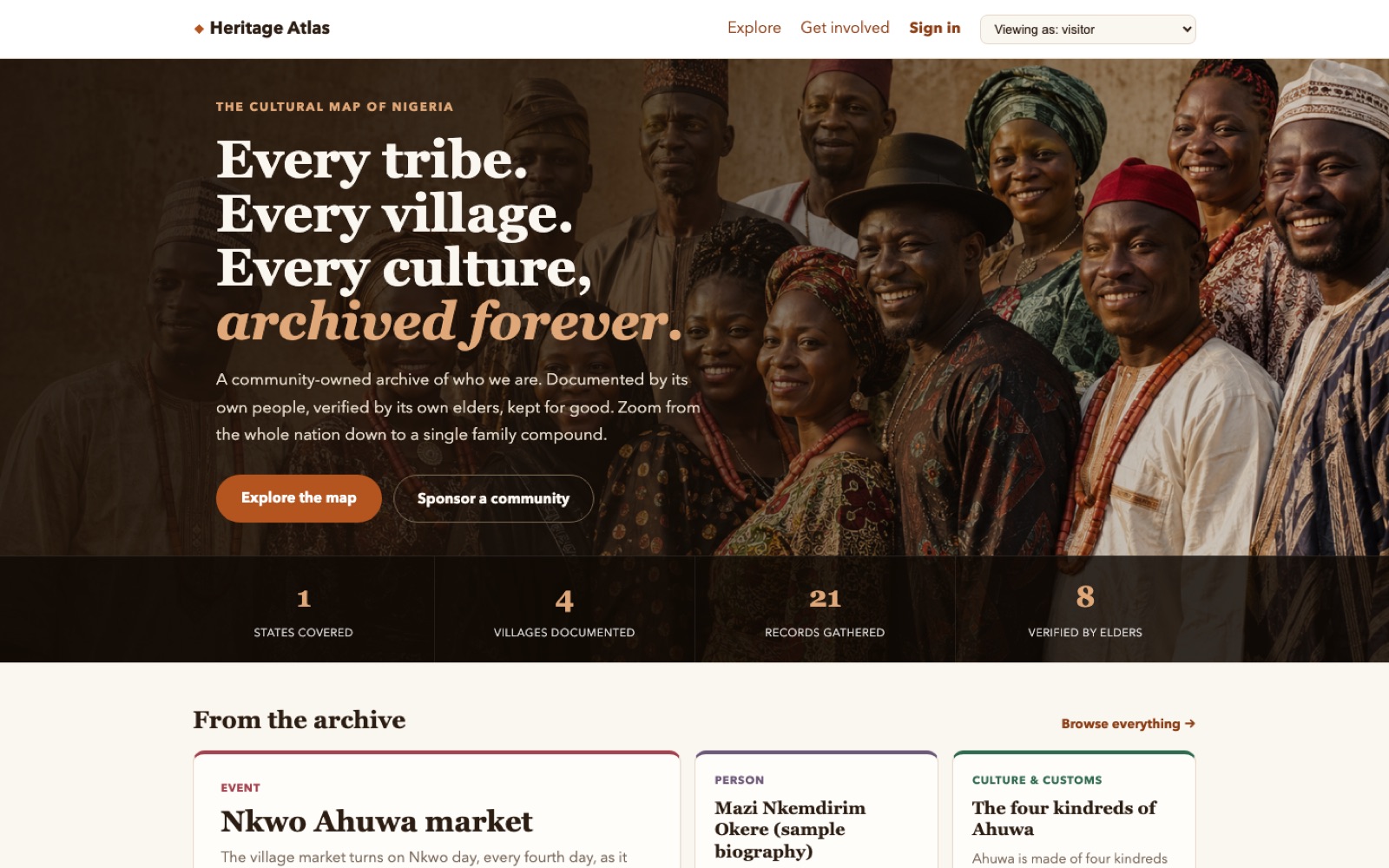
A verified archive of who we are: recorded by the people who hold it, verified by its own elders, credited by name, and kept for good. You can zoom from the whole nation down to a single family compound.
- For
- Self-commissioned
- What it is
- Web application
- What we did
- Field research, Product design, Platform engineering, Pilot delivery
- Live at
- Visit heritageatlas.ng
- Backend
- GoPostgreSQLFlag-driven config
- Frontend
- NuxtSPA
- Infrastructure
- HetznerCaddysystemdCloudflare
The problem
Nigerian cultural knowledge lives almost entirely in people. Names, lineages, festivals, crafts, the reasons behind a rite — held by elders and passed on by telling. When a custodian dies without being recorded, that knowledge is simply gone, and no institution is holding the gap.
The archives that do exist were mostly built by outsiders looking in. The communities the records describe rarely own them, rarely control them, and often cannot see them.
What we did
We built it ourselves, unasked and unpaid for, because it should exist.
The Atlas is a map you can zoom from the whole federation down to a single family compound. Every record is entered by someone from the community it belongs to, and verified by that community’s own elders before it is published. Every record credits the person who entered it and the elders who verified it.
What exists now
A live platform with the national map, community-level record entry, an elder verification flow, and the administrative tooling to run a documentation programme against it.
What it produced
The first pilot is running in Abia. Results will be published here when the field data is in, with the baseline stated alongside them.
What we learned
To be written from the pilot. This section is the point of the whole exercise: what the field exposed that the design got wrong.
Have a system that needs building?
Bring us the problem →