field-note10 min read
The company systems index
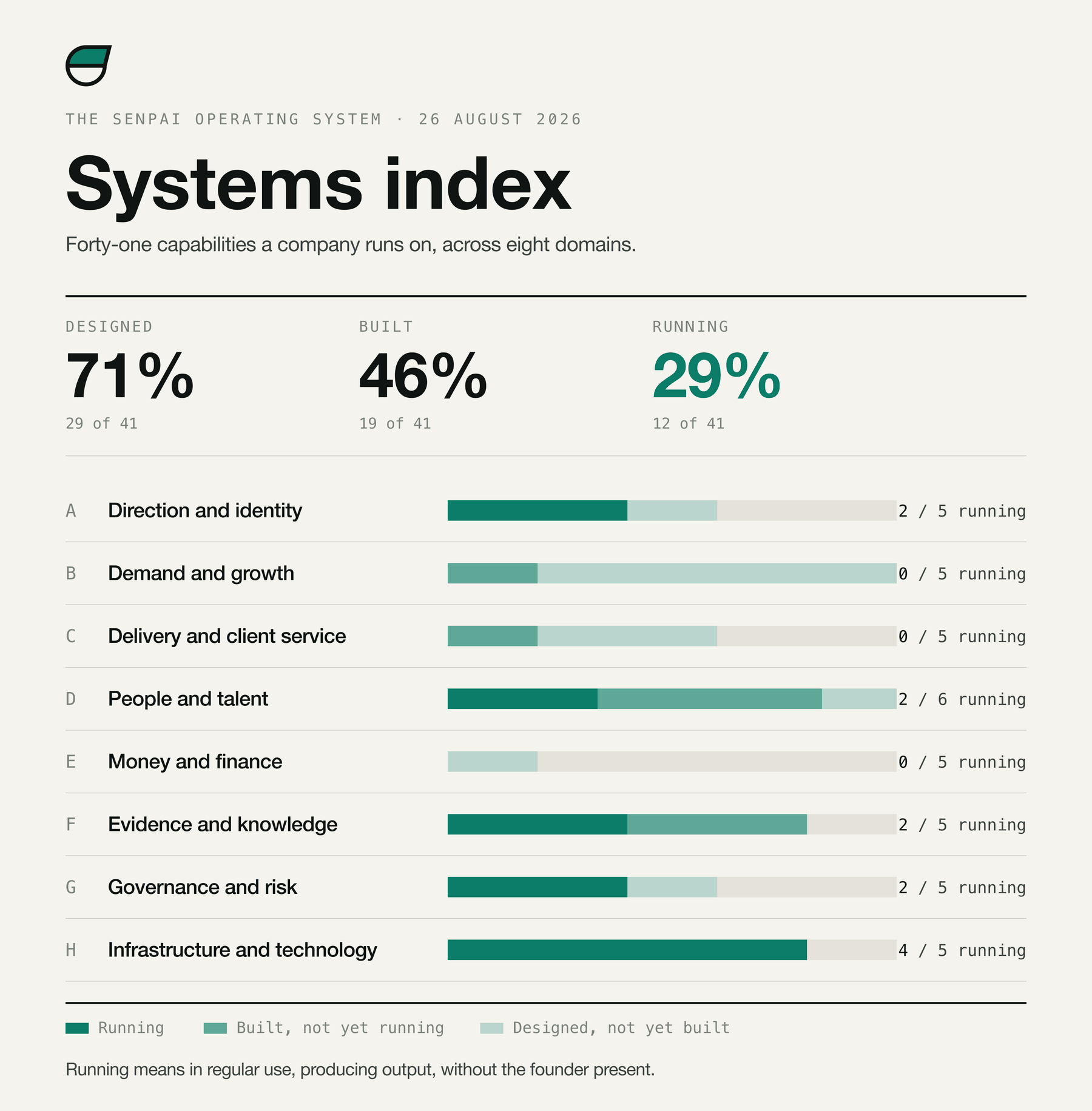
A company is the part of the work that keeps happening without you. To find out whether we have one, I listed the machinery: 41 capabilities across eight domains, and what each one has to do. Senpai scores 29 out of 100.
Last time I said a company is the part of the work that keeps happening when the people who normally do it are not there.
Then I had to find out whether we have one. A definition you cannot check is just a nice sentence, and I have been wrong about this before: in 2021 I had 2,000 members, four cohorts, revenue and graduates earning in dollars, and no company at all.
So I listed the machinery. 41 capabilities across eight domains. The list is general and should work for anyone. The scores are ours.
Two decisions about the list
Group by failure, not by department.
Sales, marketing, operations, finance, HR. That grouping comes from companies that have those departments. We have none of them and I am not sure we ever should. Grouping by org chart means grouping by an organisation I do not have.
So each domain is a job the company has to do, and a specific way it dies if it cannot. That works at one person and at four hundred.
Score on running.
Three states, and only the last one counts.
DESIGNED  ──►  BUILT  ──►  RUNNING
it is written  it works    someone else uses it,
down                       regularly, without me
A document is not a system. Working software nobody has used is not a system either. I have spent months mistaking both for progress.
A. Direction and identity
Decides what the company is for, what it will not do, and where it is going, so that people can act without asking.
Failure looks like: every judgement call routes back to the founder, because quality is their taste and taste cannot be delegated.
| Capability | What it has to do | Ours |
|---|---|---|
| Ethos and values | Hold a line when holding it costs money | Written |
| Positioning and voice | Say what the company is the same way every time | Runs |
| Canonical history | One account of where this came from that everyone can point at | Runs |
| Goals and planning | What we are trying to hit this year, and by when | Nothing |
| Decision record | What was decided, why, and what would reverse it | Nothing |
2 of 5. The voice guide governs every draft we publish and the history is written down and dated. There are no annual goals. Every decision we have made is findable only by knowing which document it is buried in, which is knowledge in a head where the head is now a folder.
B. Demand and growth
Makes work arrive on purpose instead of by luck, from people you have not met yet.
Failure looks like: the pipeline goes quiet, and by the time it is obvious you are negotiating from weakness and taking work you would have refused.
| Capability | What it has to do | Ours |
|---|---|---|
| Marketing and content | Make a stranger understand what you do and why it matters | Written |
| Business development and partnerships | Reach people through organisations that already have their trust | Written |
| Sales process and pipeline | Turn an interested person into a signature, the same way each time | Written |
| Grants, tenders and proposals | Bid for money that arrives as a programme instead of a client | Written |
| Nurture and follow-up | Stay useful to someone who is not ready yet | Built, unused |
0 of 5. Five documents, four of them written this month, and not one executes. Email capture works and nothing has ever been sent.
C. Delivery and client service
Turns a signed thing into a delivered thing, at a standard, repeatably, and keeps it working afterwards.
Failure looks like: the first project goes fine because the founder did it, the third slips, and nobody can say why the second one was better.
| Capability | What it has to do | Ours |
|---|---|---|
| Intake and qualification | Decide fast whether to take the job at all | Written |
| Scoping, pricing and proposals | Turn a problem into a price without improvising | Nothing |
| Delivery method | How a team builds the thing, the same way twice | Written |
| Quality and review | A named person checks the work before it leaves | Built, internal only |
| Handover and post-delivery support | What happens in month four | Nothing |
0 of 5. The last row is the one that bothers me. Our whole argument is that other people build, hand over and leave. If a client asked me today what happens after handover, I have nothing written down.
D. People and talent
Finds people, grows them, decides who is good at what, and pays them, without that judgement living in one person’s memory.
Failure looks like: a good person leaves and a capability leaves with them, because it was never anywhere except inside them.
| Capability | What it has to do | Ours |
|---|---|---|
| Recruiting and vetting | Find people and decide on evidence who gets in | Runs |
| Onboarding and induction | Turn an accepted person into one who knows how things work here | Built, unused |
| Roles and responsibilities | Who may do what, enforced by the system | Runs |
| Performance and review | Reviewed work producing a score attached to a person | Built, unused |
| Progression | A visible path from claimed skill to proven one, earned not granted | Built, unused |
| Compensation and offboarding | How people get paid or own a piece, and how they leave | Written |
2 of 6. Five of six are built, which makes this the most complete domain we have on paper. Three of those five have never met a real cohort.
E. Money and finance
Knows what you charge, what you are owed, what you have, and how long it lasts.
Failure looks like: you run out. Or worse, you never knew you were going to, because nothing was counting.
| Capability | What it has to do | Ours |
|---|---|---|
| Pricing and rate card | Decide what you charge once, not per conversation | Nothing |
| Invoicing and collections | Get the money you are owed, on time | Nothing |
| Bookkeeping and accounts | Keep a record of what came in and what went out | Nothing |
| Payments to people | Pay contractors properly, with tax deducted and remitted | Written |
| Capital and runway | Know how long you last | Nothing |
0 of 5, and four of them do not exist in any form. This is the domain that closes companies and it is the emptiest column in our index.
F. Evidence and knowledge
Makes what you did checkable by a stranger, and keeps what you learned where the next person can find it.
Failure looks like: years of real results you cannot prove, so every new conversation starts from zero.
| Capability | What it has to do | Ours |
|---|---|---|
| Documentation practice | Every job leaves behind the artifact showing the thinking | Runs |
| Case studies and publishing | Turn finished work into something a stranger can check | Runs |
| Impact and outcome tracking | Set targets in advance, including the point you call it a failure | Built, unused |
| Analytics and measurement | Know what people actually do on your own surfaces | Built, dormant |
| Knowledge bank | A library people can learn from without asking the founder | Nothing |
2 of 5. I have lived this failure: four years of outcomes I could not show anyone. The outcome framework is the strongest thing in this domain and it has measured nothing, because the cohort it was written for has not started.
G. Governance and risk
Keeps the company legal, insurable, and able to survive a dispute or a bad month.
Failure looks like: one unreviewed contract, one unconfirmed tax obligation, and a company with no buffer stops existing.
| Capability | What it has to do | Ours |
|---|---|---|
| Legal entity | A registered company that can sign, hold, and be held to account | Runs |
| Published policies | Rules people agree to, recorded, not assumed | Runs |
| Contracts and templates | Paper that survives a dispute | Written |
| Compliance, tax and insurance | The obligations that end you quietly if ignored | Nothing |
| Risk and continuity | Backups, a tested restore, and a register of what you own | Nothing |
2 of 5. Six contract templates are drafted and none have been through a lawyer, which means we have six documents and zero usable contracts.
H. Infrastructure and technology
The systems everything else runs on, and the ability to get them back.
Failure looks like: it stops working and nobody can restart it, or it comes back without the data.
| Capability | What it has to do | Ours |
|---|---|---|
| Core systems | The software the business actually runs on | Runs |
| Deployment and release | Ship a change without ceremony or downtime | Runs |
| Identity and access | Prove who someone is, on every request | Runs |
| Hosting and environments | Servers that stay up and cost what you expect | Runs |
| Backup, recovery and asset register | Get everything back after the worst day | Nothing |
4 of 5, and the missing one is the worst gap in the whole index. Everything this company remembers lives in a database whose restore I have never tested.
Our index: 29 out of 100
Twelve of 41 capabilities run without me. As a score out of a hundred, that is 29.
| Index score | 29 / 100 |
| Capabilities listed | 41 |
| Running | 12 |
| Written down and not running | 17 |
| Domains at zero | 3 of 8 |
| Running systems that earn money | 0 |
29 is the headline. The last row is the one that should worry me more.
And the three domains sitting at zero are consecutive. B, C and E. Demand, Delivery, Money. Put them in a line and they are the entire path from a stranger to a paid invoice:
  B. DEMAND  ──►  C. DELIVERY  ──►  E. MONEY
  0 of 5           0 of 5            0 of 5
       └──────── the whole path from a stranger
                 to a paid invoice, at zero ────┘
Everything we run is at the two ends: the servers underneath and the writing on top. The middle, the part where a company converts attention into work and work into money, is empty.
The strength is also the trap
People and brand have always been the part I am good at, and the index says so. Every capability we run is in exactly those two places: identity, evidence, the front door of the community, and the machines that hold them up.
That is not luck. It is what I reach for, so it is what got built.
It is also precisely how I ended up in 2021 with 2,000 members, a brand people recognised, and nothing that survived me getting tired. Being excellent at the thing you are already excellent at is not progress. It is the most comfortable way to avoid the work that would actually change your position.
So the number I am chasing is not the total.
Demand at 80% running. Four of five.
Marketing, business development, sales and proposals all executing. Written does not count. Contacted, quoted, followed up, recorded. Four of those five are documented well enough that I could hand them to someone tomorrow, and not one has put us in front of a single person.
Fixing Demand is the only move that unlocks two other domains, and it is the one I am least naturally inclined to do. Those two facts are related.
What is your index?
Run it on your own company. Three questions.
What are the ways your company could die? Not your departments. Your failure modes. Do that before listing anything, because the failures decide what belongs on the list.
What capability stops each one? Four to six per domain. You will name things you have never named, and that is most of the value. Three of our 41 were not on any list until I sat down: a decision record, post-delivery support, and a tested restore.
For each one, does it run without you? Not does it exist. Not do you understand it. Could someone else use it today, without asking you how.
Count the yeses, divide by the total, multiply by a hundred. That is your index. It tells you more than revenue does, because revenue can come from one person working very hard, and that is a job with extra steps.
Ours is 29 out of 100. In two years the question will not be whether that was impressive. It will be whether it moved, and whether we said so if it did not.
Stay updated
We are building the digital infrastructure Africa needs, and publishing the whole thing as it happens. Field notes from inside the work, research, case studies, and the decisions that turned out wrong. Roughly weekly.
No pitch, and one click to leave.
SENPAI is a social impact design and technology company in Nigeria. We publish what we learn from the work, including the parts that did not go to plan.
Bring us a problem